
从“五轮”看眼健康 —— 谈何为中医眼科 Understanding Eye Health Through the “Five Wheels” Theory — What Is TCM Ophthalmology?
Understanding Eye Health Through the “Five Wheels” Theory — What Is TCM Ophthalmology?
在门诊中,我常遇到患者提出同一个疑问:“中医也有眼科吗?”
在大众的印象中,中医往往与内科调理、针灸推拿密切相关。事实上,中医眼科不仅存在,而且早已形成一套拥有数千年的完整理论与系统体系。它并非单纯调理眼部疾病,而是从整体出发,理解眼睛与人体脏腑、气血运行之间的密切关系。眼病的发生往往不只局限于眼部:既可能是独立疾病,也可能源于全身失调,或与其他疾病同时存在。因此,在复杂的临床情形下,强调整体观的中医眼科学尤具实践意义。
随着社会发展,相关医疗需求不断增加。心理压力上升、外伤机会增多、电子产品普及及人口老龄化,均使各类眼病(如青光眼、白内障、干眼症、视疲劳、飞蚊症、眼睑下垂、眼皮振跳、年龄相关性黄斑变性、视网膜脱离、糖尿病视网膜病变等)愈发常见,同时人们对视觉健康与生活品质的要求亦持续提高。
在此背景下,中医眼科学在整体调理、慢性管理与长期保健方面的优势愈发凸显,也使其具有重要的临床价值与社会意义。
在临床实践中,例如于跨视代中医诊所(GEN EYE TCM),我们始终强调:每一位前来就诊的眼科患者,均需先进行全面而系统的眼部检查,以明确眼睛的客观状况与病变性质。相关检查由专业视光学师负责执行,随后由我进行报告解读与临床评估,让患者清楚了解自身眼睛的真实情况与潜在风险。
在充分掌握检查结果后,方可结合中医辨证理论制定针对性的调理方案;若评估发现需要进一步影像或专科检查,则会建议患者至西医眼科同时进行诊疗。通过这样的协作模式,使中医整体调理与现代眼科医学能够相互配合,从而更全面地协助患者保护视觉健康。
In my clinical practice, I am often asked the same question by patients:
“Does Traditional Chinese Medicine (TCM) really have Ophthalmology?”
In public perception, TCM is commonly associated with internal medicine, acupuncture, and manual therapies. In reality, TCM Ophthalmology not only exists, but has developed into a well-established discipline with thousands of years of theoretical foundation and systematic clinical practice.
Rather than focusing solely on the eyes as isolated organs, TCM approaches eye diseases from a holistic perspective, recognizing the close relationship between the eyes and the body’s internal organs, as well as the circulation of Qi and blood. Eye disorders are often not confined to the eyes alone — they may arise independently, stem from systemic imbalance, or coexist with other medical conditions. For this reason, the holistic framework of TCM Ophthalmology holds significant practical value in complex clinical scenarios.
With societal development, demand for eye care continues to rise. Increased psychological stress, higher risk of trauma, widespread use of digital devices, and population aging have all contributed to the growing prevalence of eye conditions such as glaucoma, cataracts, dry eye disease, digital eye strain, eye fatigue, floaters, ptosis, eyelid twitching, age-related macular degeneration, retinal detachment, and diabetic retinopathy. At the same time, expectations for visual health and quality of life are steadily increasing.
Against this backdrop, the strengths of TCM Ophthalmology — particularly in holistic regulation, chronic disease management, and long-term preventive care — have become increasingly evident, underscoring its clinical and societal importance.
In clinical settings, such as at GEN EYE TCM, we emphasize that every patient seeking TCM eye care should first undergo a comprehensive and systematic eye examination to establish an objective understanding of their ocular condition. These assessments are conducted by professional optometrists, after which I personally review and explain the findings, enabling patients to clearly understand their eye health status and potential risks.
Only after thoroughly evaluating the results do we formulate individualized TCM support plans based on syndrome differentiation. If further imaging or specialist investigations are required, patients are advised to seek concurrent care from Western ophthalmologists. Through such collaborative care models, holistic TCM regulation and modern ophthalmic medicine can complement each other, providing more comprehensive protection for visual health.
眼睛并非孤立器官
早在经典医籍《黄帝内经》中便提出:“目为五脏六腑之精所聚。”
这句话揭示了中医眼科最核心的理念 —— 眼睛不是独立运作的器官,而是全身精气汇聚之处。换言之,许多眼病的根源,并不只在眼部,而与整体健康状态密切相关。历代医家不断发展与完善眼科理论,逐渐形成独立体系,对角膜病、白内障、青光眼、眼底病等多种眼疾均有详细记载与调理经验。
在临床上,我们也确实发现,长期压力大、睡眠不足、体质虚弱的人,更容易出现视疲劳、干眼、视力波动等问题。
The Eyes Are Not Isolated Organs
As early as the classical medical text Huangdi Neijing (The Yellow Emperor’s Inner Canon), it was stated: “The eyes are the gathering place of the essence of the five zang and six fu organs.”
This principle reflects one of the most fundamental concepts of TCM Ophthalmology — the eyes do not function independently, but represent a convergence of the body’s vital essence. In other words, the root causes of many eye diseases lie not solely in the eyes, but in overall systemic health.
Over centuries, TCM physicians have refined ophthalmic theories, forming an independent specialty with detailed descriptions and clinical experiences for conditions such as corneal diseases, cataracts, glaucoma, and retinal disorders.
Clinically, we also observe that individuals experiencing chronic stress, inadequate sleep, or constitutional weakness are more prone to visual fatigue, dry eye symptoms, and fluctuating vision.
中医如何看待眼睛?
中医认为,眼睛是人体整体健康的“窗口”,其功能与以下脏腑关系尤为密切:
1. 肝开窍于目
肝主藏血、主疏泄;若肝血不足,容易出现视力疲劳、干涩、视物模糊。
2. 肾精上注于目
肾主精,精气充足则视力清晰;肾虚则可能导致视力衰退、老花、夜盲等问题。
3. 脾主运化,脾主肌肉
脾气虚弱可影响气血生化,导致眼部营养不足,常见为黄斑问题或眼疲劳。
因此,中医调理眼病强调“整体调理”,不仅关注眼部本身,更重视全身状态。
How Does TCM View the Eyes?
In TCM theory, the eyes are regarded as a “window” into overall health, closely connected with specific internal organs:
1. The Liver Opens into the Eyes
The liver stores blood and regulates its flow. Liver blood deficiency may lead to visual fatigue, dryness, and blurred vision.
2. Kidney Essence Nourishes the Eyes
The kidneys govern essence. Adequate kidney essence supports clear vision, while deficiency may result in declining vision, presbyopia, or night blindness.
3. The Spleen Governs Transformation and Muscles
Spleen deficiency affects the production of Qi and blood, leading to insufficient nourishment of the eyes, commonly presenting as macular problems or eye fatigue.
Therefore, TCM management of eye diseases emphasizes holistic regulation, addressing both ocular symptoms and systemic health.
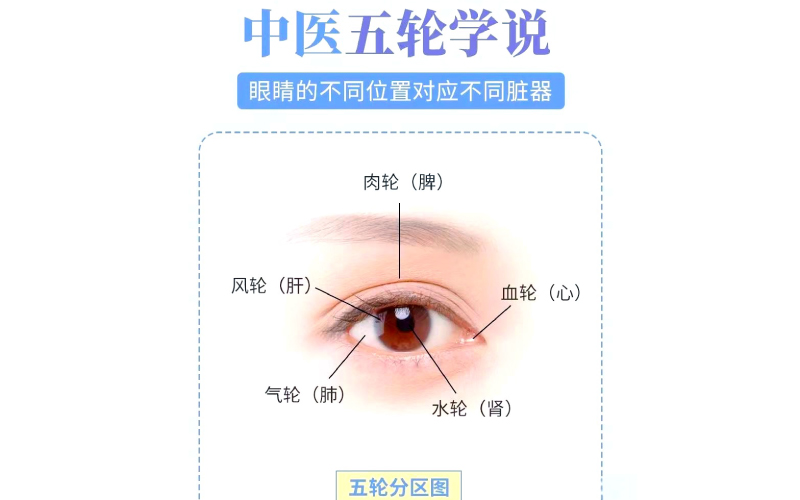
理解眼病的关键:五轮学说
中医眼科最具代表性的理论之一,是“五轮学说”。
该学说将眼部不同结构与五脏功能相对应:
- 内外眼角为“血轮”,属心
- 白睛为“气轮”,属肺
- 黑睛为“风轮”,属肝
- 眼睑为“肉轮”,属脾
- 瞳神为“水轮”,属肾
这套理论的意义在于,它提供了一种整体诊断思维:眼部出现的变化,往往反映相应脏腑功能的失调。
例如,肝血不足者容易视力疲劳;脾气虚弱者可能眼睑沉重;肾精亏虚则常见视力退化。这些现象在临床上十分常见。
The Key to Understanding Eye Disorders: The Five Wheels Theory
One of the most representative concepts in TCM Ophthalmology is the Five Wheels Theory, which correlates eye structures with internal organs:
- Inner and outer canthi — Blood Wheel (Heart)
- Sclera — Qi Wheel (Lung)
- Cornea/iris region — Wind Wheel (Liver)
- Eyelids — Flesh Wheel (Spleen)
- Pupil — Water Wheel (Kidney)
This framework provides a holistic diagnostic approach: changes observed in specific parts of the eye may reflect dysfunction in corresponding organs.
For example, Liver Blood Deficiency may manifest as visual fatigue, Spleen Qi Deficiency as heavy eyelids, and Kidney Essence Deficiency as progressive vision decline — patterns frequently seen in clinical practice.
中医眼科的调理思路
中医眼科强调“整体调理,标本兼顾”。
首先是辨证施治。每位患者的体质、病因、生活习惯不同,因此调理方案也需个别制定,而非一概而论。
其次是内外兼顾。常见方法包括中药调理体质、针灸促进眼部气血循环,以及外治法如熏洗等。
此外,中医特别重视预防与养护。调节作息、改善用眼习惯、缓解情绪压力,往往是稳定眼病的重要关键。
Therapeutic Principles of TCM Ophthalmology
TCM ophthalmology emphasizes holistic treatment addressing both root and manifestation.
First is syndrome differentiation. Since each patient differs in constitution, etiology, and lifestyle, treatment plans must be individualized rather than standardized.
Second is the integration of internal and external therapies, including herbal medicine to regulate systemic balance, eye acupuncture to improve ocular circulation, and external methods such as herbal washes.
Prevention and long-term care are also highly valued. Adjusting lifestyle habits, improving visual ergonomics, and managing emotional stress are often key to stabilizing eye conditions.
中医眼科的现代意义
随着电子产品普及,用眼过度已成为现代社会的普遍现象。越来越多年轻人出现干眼、视疲劳甚至早期退化问题。
在这类慢性、长期管理的眼疾中,中医眼科的优势逐渐显现 —— 它强调整体调理与长期稳定,而非仅处理局部症状。
因此,中医眼科不仅是一门调理疾病的学科,更是一套维护视觉健康、提升生活质量的重要医学体系。
The Modern Relevance of TCM Ophthalmology
With the widespread use of digital devices, excessive visual strain has become a common issue. Increasingly, younger individuals experience dry eyes, visual fatigue, and early degenerative changes.
In chronic conditions requiring long-term management, the strengths of TCM Ophthalmology are becoming more apparent — emphasizing systemic balance and sustained stability rather than focusing solely on localized symptoms.
Thus, TCM Ophthalmology is not merely a therapeutic discipline, but also an important medical system for preserving visual health and enhancing quality of life.
结语
中医眼科并非神秘或古老的疗法,而是一门兼具历史传承与现代应用价值的医学分支。通过整体观念与辨证施治,中医为眼健康提供了另一种稳健而长远的守护方式。
从“五轮学说”到整体辨证理念,中医眼科提供了另一种现代医学的视角。它提醒我们:守护视力,不只是保护眼睛,更是调养全身。
理解这一点,正是认识中医眼科的真正起点。
Conclusion
TCM Ophthalmology is neither mysterious nor outdated. It is a medical specialty that combines deep historical roots with modern clinical relevance. Through holistic principles and individualized diagnosis, TCM offers a stable and long-term approach to safeguarding eye health.
From the Five Wheels Theory to systemic pattern differentiation, TCM Ophthalmology provides a complementary perspective to modern medicine — reminding us that protecting vision is not only about caring for the eyes, but also about nurturing the whole body.
Understanding this principle is the true starting point for appreciating TCM Ophthalmology.
