
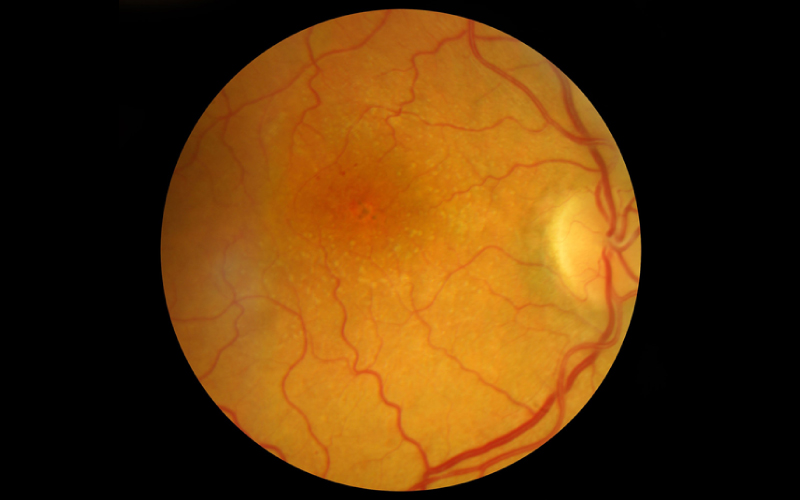
Age-Related Macular Degeneration (AMD)
The macula is the area of the retina responsible for sharp, detailed central vision. Macular degeneration occurs when the function of this area becomes impaired. Age-Related Macular Degeneration (AMD), also known as senile macular degeneration, is a leading eye condition affecting central vision in middle-aged and older adults. It predominantly occurs in individuals over the age of 50 and can severely impact central vision. AMD is classified into two primary types: Dry AMD and Wet AMD.
Dry Macular Degeneration (Dry AMD)
Dry AMD is the more common form of the condition.
- Cause & Progression: As we age, the light-sensitive cells in the macular region gradually thin and atrophy. Simultaneously, yellowish deposits known as drusen accumulate beneath the retina. These changes lead to a gradual deterioration of macular function and a slow decline in central vision.
- Symptoms: Early symptoms are usually unnoticeable, often presenting only as mild blurriness, as if a thin veil or mist is blocking the view. As age increases or the condition progresses, vision slowly declines and worsens day by day, potentially resulting in a fixed dark shadow in the center of the visual field.
Wet Macular Degeneration (Wet AMD)
Although Wet AMD accounts for a minority of cases, its damage to vision is much more severe and rapid.
- Cause & Progression: The hallmark of Wet AMD is the growth of abnormal, fragile new blood vessels beneath the macula. These vessels easily leak blood or fluid, causing swelling (edema), lifting of the macula, and subsequent scarring.
- Symptoms: Vision loss in Wet AMD is typically rapid. Patients may notice that straight lines appear distorted or wavy (metamorphopsia), experience a sudden and sharp drop in central vision, or see a prominent dark shadow or blind spot blocking their central field of vision.
- The Importance of Early Detection: Because Wet AMD progresses rapidly, early detection and timely treatment are critical. Regular eye examinations are highly recommended for the general public, especially for high-risk individuals with a family history of the condition.
How Traditional Chinese Medicine (TCM) Views AMD
In TCM theory, Age-Related Macular Degeneration (AMD) falls under the category of “Shi Zhan Hun Miao” (Dim and Indistinct Vision). TCM believes that AMD is closely linked to the decline of organ functions, particularly deficiencies in the Liver, Kidney, and Spleen. Since “the Spleen governs the macula,” the relationship between AMD and the Spleen is exceptionally profound.
- Deficiency of Kidney Essence: The Kidneys store essence, which flows upward to nourish the eyes. As people age, Kidney Qi naturally declines and Kidney Essence becomes depleted, depriving the eyes of sufficient nourishment and causing the macular region to gradually atrophy and degenerate.
- Deficiency of Both Liver and Kidney: The Liver stores blood and opens into the eyes, while the Kidneys store essence to nourish them. In older adults, a dual deficiency of the Liver and Kidney leads to depleted essence and blood. This leaves the eyes malnourished, triggering the onset of macular degeneration.
- Yin Deficiency with Hyperactive Fire: A naturally Yin-deficient constitution, or emotional strain and exhaustion, can lead to Liver and Kidney Yin deficiency. This generates internal deficient fire that flares upward, injuring the ocular vessels and causing hemorrhage, exudation, or edema in the macular area.
- Spleen Qi Deficiency: The Spleen governs transformation and transportation, serving as the source of Qi and Blood generation. A weak Spleen fails to produce enough Qi and blood to ascend and nourish the eyes. Because the eyes rely heavily on a steady influx of Qi and blood, this deficiency leads to a decline in macular function.
- Internal Accumulation of Phlegm-Dampness: A poor diet combined with a weakened Spleen and declining digestive function in old age prevents the proper transformation of fluids, which then pool into phlegm-dampness. This accumulation obstructs the circulation of Qi and blood, rising to the eyes and stagnating in the fundus to form macular exudates and edema.
- Mutual Binding of Phlegm and Blood Stasis: High stress and emotional unrest injure the Liver Qi. When Qi is stagnant, blood flow stagnates as well, forming blood stasis. Concurrently, Spleen deficiency generates phlegm. Phlegm-dampness and blood stasis interlock and block the fundus of the eye, resulting in macular bleeding, exudation, and edema, which over time lead to scarring and pigmentation.
TCM Support for Dry Macular Degeneration
TCM views Dry AMD primarily as a Deficiency syndrome, dominated by Liver-Kidney deficiency and Spleen Qi deficiency. The therapeutic principle is to nourish the Liver and Kidneys, while boosting Qi and nourishing the Blood.
1. Oral Herbal Medicine
- Modified Qiju Dihuang Pills (杞菊地黄丸加减): This classic formula nourishes Liver and Kidney Yin and is widely used for eye diseases rooted in Yin deficiency. It can be modified by adding Nu Zhen Zi (Glossy Privet Fruit) and Han Lian Cao (Eclipta Herb) to strengthen the Yin-nourishing effect; Huang Jing (Siberian Solomonseal Rhizome) and Tu Si Zi (Dodder Seed) to replenish essence; or Zhi Mu (Anemarrhena Rhizome) and Huang Bai (Phellodendron Bark) to clear deficient heat.
- Modified Shenling Baizhu Powder (参苓白术散加减): If the patient experiences Spleen deficiency symptoms such as fatigue and poor appetite, this formula can be used to strengthen the Spleen and boost Qi, improving blood production to indirectly nourish the eyes.
- For pronounced macular edema: Herbs like Ze Lan (Shiny Bugleweed Herba) and Yi Mu Cao (Motherwort Herb) may be added to promote urination and reduce swelling.
2. Acupuncture
Acupuncture helps unblock meridians and harmonize Qi and blood. Frequently used acupoints include:
- Periocular (Around the Eyes): Jingming (BL1), Qiuhou (EX-HN7), Chengqi (ST1), Tongziliao (GB1), Zanzhu (BL2), and Taiyang (EX-HN5) to directly enhance local blood circulation.
- Systemic (Body): Ganshu (BL18), Shenshu (BL23), Pishu (BL20), Zusanli (ST36), and Sanyinjiao (SP6) to regulate organ functions and improve overall constitution.
TCM Support for Wet Macular Degeneration
Wet AMD leans more toward Excess syndromes manifested as the mutual binding of phlegm and blood stasis, as well as the internal accumulation of phlegm-dampness. TCM views this as an excess presentation superimposed on an underlying deficiency. The therapeutic principle is to invigorate blood, resolve stasis, promote urination, and reduce swelling.
1. Oral Herbal Medicine
- Modified Taohong Siwu Decoction (桃红四物汤加减): A classic formula for invigorating blood and dispelling stasis. Adding herbs like Dan Shen (Red Sage Root), Chuan Xiong (Szechuan Lovage Rhizome), and Chi Shao (Red Peony Root) helps promote blood circulation in the fundus, unblock collateral vessels, and dissipate blood stasis.
- Modified Xuefu Zhuyu Decoction (血府逐瘀汤加减): If symptoms of blood stasis are severe, this formula offers stronger potency to improve fundus bleeding and fluid leakage.
- For severe exudation: Herbs like Ze Xie (Oriental Water Plantain Rhizome) and Fu Ling (Poria) can be added to drain dampness and reduce swelling.
- For prolonged, unabsorbed bleeding: Herbs like Dan Shen (Red Sage Root) and Ze Lan (Shiny Bugleweed Herba) can be added to activate blood and resolve stagnation.
- For prominent scarring: Herbs like Zhe Bei Mu (Thunberg Fritillary Bulb) and Ji Nei Jin (Chicken Gizzard Membrane) can be added to soften hardness and dissipate nodules.
2. Acupuncture
For Wet AMD, acupuncture not only addresses the underlying deficiency but also actively promotes blood circulation to resolve stasis.
- Periocular Acupoints: Same as Dry AMD.
- Systemic Acupoints: Geshu (BL17 – the influential point of blood), Taichong (LR3), Xuehai (SP10), Baihui (GV20), and Hegu (LI4) to regulate Qi and blood and dissolve stagnation.
TCM Syndrome Differentiation:
AMD presentations are rarely singular and often feature a mix of deficiency and excess (e.g., internal accumulation of phlegm-dampness arising alongside a deficiency of Kidney essence). Therefore, TCM protocols are dynamically adjusted based on the patient’s evolving condition.
Dietary and Lifestyle Advice
Regardless of the TCM syndrome type, lifestyle cultivation (Yang Sheng) is universally emphasized.
- Rest & Emotion: Ensure adequate rest, avoid overexertion, and maintain a calm, cheerful mood.
- Dietary Balance: Eat regular, light, and nutritious meals. Increase intake of dark green leafy vegetables rich in lutein and zeaxanthin (such as spinach and kale) and fish rich in Omega-3 fatty acids. Avoid greasy, heavy, spicy, pungent, deep-fried, barbecued, and raw or cold foods.
- Supplements for Dry AMD: Patients with Dry AMD may supplement with micronutrients and vitamins (such as Vitamin C and Vitamin E) to protect photoreceptor cells.
- Quit Smoking and Alcohol: Smoking and excessive drinking are major risk factors that accelerate the progression of macular degeneration.
- Sun Protection: Since solar radiation and visible bright light can cause macular damage, wear a wide-brimmed hat in bright sunlight, and wear filtered sunglasses around snow or water to protect your eyes from light damage.
- Monitor the Healthy Eye: If AMD has already developed in one eye, strictly monitor the healthy eye and seek immediate medical attention if any changes occur.
Recommended Dietary Alternatives (Food Therapy)
The following dietary recipes are designed to complement standard care based on specific TCM patterns, aiming to improve eye health by nourishing organs, boosting Qi, or clearing phlegm and collateral channels.
1. Kidney Essence Deficiency Type
Characterized by a slow decline in vision accompanied by dizziness, tinnitus, and soreness or weakness in the lower back and knees.
- Goji Berry and Mulberry Porridge (枸杞桑葚粥)
- Ingredients: Goji berries 12g, Mulberry fruit 12g, Black rice 50g.
- Preparation: Wash the black rice. Place it in a pot along with the goji berries and mulberries. Add water, bring to a boil over high heat, then reduce to low heat and simmer into a porridge.
- Benefits: Both goji berries and mulberries nourish the Liver and Kidneys to improve eyesight. Black rice enters the Kidney meridian to replenish essence and brighten the eyes, helping relieve blurred or poor night vision.
- Black Bean and Sesame Paste (黑豆芝麻糊)
- Ingredients: Black beans 50g, Black sesame seeds 30g, Walnut kernels 10g.
- Preparation: Toast the black beans, black sesame seeds, and walnuts until fragrant. Grind them into a fine powder. Mix an appropriate amount with warm water daily to form a smooth paste.
- Benefits: Black beans and black sesames enter the Kidney meridian, helping reinforce the Kidneys. Walnuts supplement the Kidneys and brain. This blend replenishes Kidney essence to relieve eye issues stemming from deficiency.
2. Spleen Qi Deficiency Type
Characterized by blurred vision, a pale complexion, general fatigue, and palpitations.
- Mutton and Angelica Soup (当归羊肉汤)
- Ingredients: Mutton/Lamb 250g, Angelica root (Dang Gui) 12g, Fresh ginger slices.
- Preparation: Cut the meat into chunks. Place it in a stewing pot with the angelica root and ginger slices. Add water and stew until the meat is tender.
- Benefits: Mutton is warm in nature and tonifies Qi and blood, while angelica root is an excellent herb for nourishing and activating blood. This soup is ideal for dim vision and a dull complexion caused by Qi and blood deficiency.
- Red Date and Longan Porridge (红枣桂圆粥)
- Ingredients: Red dates 5 pieces, Longan aril 10g, Millet 50g.
- Preparation: Wash the millet. Place it in a pot with the red dates and longan, add water, and cook into a porridge.
- Benefits: Red dates and longan nourish the Heart and Spleen while calming the mind. Millet strengthens the Spleen and boosts Qi, working synergistically to enhance blood production and provide ample nourishment to the eyes.
3. Phlegm-Dampness / Phlegm-Stasis Binding Type
Characterized by a sharp drop in vision, distorted vision (wavy lines), heavy limbs, and a thick, greasy tongue coating.
- Hawthorn and Barley Porridge (山楂薏米粥)
- Ingredients: Dried hawthorn fruit 15g, Coix seed (Barley/Yimi) 30g, Aged tangerine peel (Chen Pi) 3g.
- Preparation: Place all ingredients into a pot, add water, and cook into a porridge.
- Benefits: Hawthorn invigorates blood and dispels stasis while aiding digestion. Coix seed strengthens the Spleen and drains dampness, helping eliminate excess fluid. Tangerine peel regulates Qi and transforms phlegm to clear obstructions.
- Stewed Chicken with Notoginseng (三七炖鸡)
- Ingredients: Notoginseng powder (San Qi) 3g, Chicken 250g.
- Preparation: Cut the chicken into pieces. Place it in a stewing pot along with the notoginseng powder, and double-boil (steam in a water bath) until cooked.
- Benefits: Notoginseng is a premier herb for transforming blood stasis and stopping bleeding, which helps improve microcirculation in the fundus of the eye, reducing fluid leakage and hemorrhage.
⚠️ Important Reminder for Dietary Therapy:
Dietary therapy is strictly a supportive measure and cannot replace professional medical diagnosis and treatment. Before starting any dietary regimen, please consult a registered TCM practitioner to ensure it suits your unique constitution and current health status. Maintaining a balanced diet rich in fresh vegetables and fruits alongside a healthy lifestyle remains vital for long-term eye health.
