
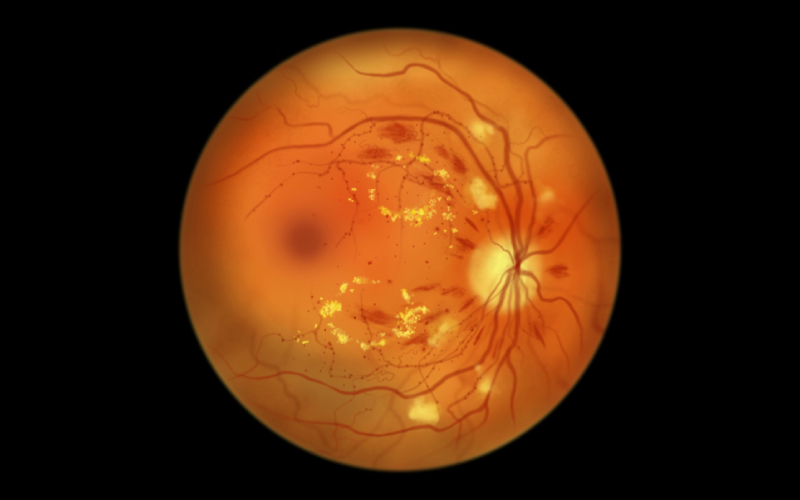
Diabetic Retinopathy (DR): TCM Ophthalmic Insights on Syndrome Differentiation and Conditioning Strategies
Diabetic Retinopathy (DR), commonly referred to in Chinese as “Tang Wang” (糖网), is an ocular complication caused by diabetes. It stems from long-term high blood sugar damaging the retinal blood vessels and stands as one of the major leading causes of blindness among older adults.
Pathological Progression
The development of diabetic retinopathy is gradual and typically divided into two primary stages:
- Non-proliferative Diabetic Retinopathy (NPDR): This is the early stage of the disease. Chronic high blood sugar weakens and expands the walls of the tiny blood vessels in the retina, forming microaneurysms. The permeability of these vessels increases, causing blood, lipids, and proteins to leak into the retinal tissue. This results in dot-and-blot haemorrhages, hard exudates, and cotton-wool spots. If this leakage occurs in the central area of the retina — the macula — it leads to Diabetic Macular Edema (DME), which is the primary cause of vision loss during this stage.
- Proliferative Diabetic Retinopathy (PDR): This is the advanced and more severe stage. Due to widespread vessel occlusion, the retina suffers from ischemia (restricted blood supply) and hypoxia (oxygen deprivation). In response to this lack of oxygen, the retina releases a substance called Vascular Endothelial Growth Factor (VEGF), which stimulates the growth of new blood vessels. These neovascular vessels are fragile and abnormal; they rupture easily, leading to extensive retinal haemorrhages. Large amounts of bleeding can cause vitreous opacity, vitreous haemorrhage, and the formation of grayish-white proliferative bands. Concurrently, fibrovascular membranes form around these new vessels. When these membranes contract, they pull on the retina, which can ultimately lead to tractional retinal detachment — a severe complication causing permanent blindness.
Clinical Symptoms
Early-stage diabetic retinopathy typically presents with no obvious symptoms, which is why it is so frequently overlooked. As the condition advances, symptoms may include:
- Blurred or Fluctuating Vision: Particularly noticeable when blood sugar is poorly controlled.
- Dark Shadows or Floaters: This is often a manifestation of vitreous haemorrhage.
- Partial Loss of Visual Field or Sudden Vision Drop: May be caused by severe macular edema or retinal detachment.
- Poor Night Vision.
TCM Ophthalmic Conditioning for Diabetic Retinopathy
Traditional Chinese Medicine (TCM) ophthalmology approaches diabetic retinopathy (DR) through a unique theoretical framework. Instead of viewing DR purely as a localized eye disease, TCM sees it as an ocular manifestation of the patient’s overarching systemic diabetic pathogenesis. TCM categorizes DR under the scope of Xiao Ke Zheng (消渴证 – wasting-thirst syndrome / diabetes). Based on specific presentations like failing vision, fundus haemorrhages, and edema, it is sub-classified into terms like Shi Zhan Hun Miao (视瞻昏渺 – dimness of vision), Yun Wu Yi Jing (云雾移睛 – clouds and mists drifting in the eye / floaters), and Xue Guan Tong Shen (血灌瞳神 – blood flooding the pupil).
TCM Etiology and Pathogenesis
TCM holds that the fundamental pathogenesis of DR is driven by Yin Deficiency and Dry-Heat, which persists throughout the course of the disease. Prolonged wasting-thirst damages both Qi and Yin, generating internal heat from Yin deficiency. This heat scorches the body’s fluids, causing the circulation of Qi and Blood to become sluggish. Eventually, this develops into Blood Stasis Obstructing the Collaterals. The resulting stagnation in the ocular meridians deprives the retina of essential nourishment, and in severe cases, forces blood to escape outward from the vessels, leading to fundus haemorrhages.
Based on clinical manifestations, TCM generally differentiates DR into the following syndrome types:
- Qi and Yin Deficiency with Blood Stasis Obstructing Collaterals Type: This is the most common presentation. Patients experience blurred vision, declining eyesight, and drifting dark shadows. Fundus examinations reveal microaneurysms, haemorrhages, or exudates. Systemic signs include physical exhaustion, lack of energy, dry mouth, spontaneous sweating, excessive thirst (polydipsia), frequent urination (polyuria), increased appetite (polyphagia), and numbness in the limbs.
- Therapeutic Principle: Benefit Qi and nourish Yin, invigorate Blood and resolve stasis.
- Common Formulas: Shengmai Drink (生脉饮) is frequently used to benefit Qi and nourish Yin; Xuefu Zhuyu Decoction (血府逐瘀汤) or Taohong Siwu Decoction (桃红四物汤) are selected with modifications to invigorate Blood and resolve stasis.
- Liver and Kidney Yin Deficiency with Deficient Fire Flaring Upward Type: Patients present with a marked decline in vision, floaters, dry eyes, and dim, hazy vision. Systemic symptoms include dizziness, tinnitus, weakness or soreness in the lower back and knees, insomnia, vivid dreaming, tidal fevers, and night sweats.
- Therapeutic Principle: Nourish the Liver and Kidney, enrich Yin and clear heat.
- Common Formulas: Qiju Dihuang Pills (杞菊地黄丸) or Yiguan Jian (一贯煎).
- Spleen and Stomach Deficiency with Internal Damp-Heat Retention Type: Patients present with visual decline and floaters, accompanied by fundus edema, exudates, and cotton-wool spots. Systemic symptoms include a heavy sensation in the body, a sallow complexion, poor appetite, abdominal distension, and loose stools.
- Therapeutic Principle: Strengthen the Spleen and benefit Qi, clear heat and drain dampness.
- Common Formulas: Shenling Baizhu Powder (参苓白术散) or Sijunzi Decoction (四君子汤) with modifications.
- Phlegm and Stasis Interlocking with Impaired Meridians Type: Patients experience declining vision and floaters. Fundus evaluation reveals retinal edema, exudates, neovascularization, haemorrhages, and fibrovascular membranes; the vitreous may exhibit grayish-white proliferative bands or traction on the retina. Systemic signs include localized, fixed stabbing pain, and a dark purple hue on the lips or limbs.
- Therapeutic Principle: Strengthen the Spleen and dry dampness, resolve phlegm and dispel stasis.
- Common Formulas: Wendan Decoction (温胆汤) with modifications.
Methods of TCM Ophthalmic Conditioning for DR
TCM ophthalmic care emphasizes a holistic view. Alongside oral herbal medicine, it frequently incorporates other traditional therapies to address both the symptoms and the root cause.
- Oral Herbal Medicine: Based on the syndrome differentiations detailed above, a TCM practitioner prescribes personalized herbal formulas. These herbs address the root causes of Qi-Yin deficiency and blood stasis, thereby optimizing fundus microcirculation while easing edema and haemorrhages.
- Acupuncture Therapy (Contraindicated for patients with active neovascularization or retinal detachment): Acupuncture stimulates localized ocular and systemic points to unblock meridians, regulate the flow of Qi and blood, and accelerate the absorption of fundus lesions. Commonly utilized points include Taiyang (EX-HN5), Jingming (BL1), Zanzhu (BL2), Sibai (ST2), Qiuhou (EX-HN7), Taichong (LR3), Baihui (GV20), Hegu (LI4), Guangming (GB37), Zusanli (ST36), and Sanyinjiao (SP6).
The Power of Integrative Medicine
Combining Chinese and Western medicine is now a well-established strategy for managing DR. Western medicine — utilizing retinal laser photocoagulation, intravitreal anti-VEGF injections, and vitrectomy — can rapidly and precisely control acute lesions, particularly during aggressive stages of progression. Meanwhile, TCM holistically modulates the patient’s constitution, improves overall Qi, Blood, and organ functions, reduces recurrence rates, and slows the long-term progression of the disease. Together, they provide a comprehensive and durable care plan.
Dietary Therapy Recommendations
These dietary recipes are designed as supportive daily care to help patients manage symptoms based on their specific TCM syndrome types.
1. Qi and Yin Deficiency, Blood Stasis Obstructing Collaterals Type
Core Strategy: Benefit Qi, nourish Yin, invigorate Blood, and resolve stasis.
- Astragalus and Angelica Chicken Soup (黄芪当归炖鸡汤)
- Ingredients: Huang Qi (Astragalus Root) 10g, Dang Gui (Angelica Root) 10g, chicken 200g, 3–5 red dates, a few slices of ginger.
- Preparation: Blanch the chicken. Place it into a stewing pot along with the Huang Qi, Dang Gui, red dates, and ginger. Add an appropriate amount of water and double-boil for 1–2 hours.
- Benefits: Huang Qi replenishes Qi, while Dang Gui nourishes and moves Blood. Together, they tonify Qi and Blood to optimize systemic and ocular microcirculation.
- Double-Boiled Pork with Notoginseng (三七炖瘦肉)
- Ingredients: San Qi (Notoginseng) powder 3g, lean pork 100g.
- Preparation: Slice the lean pork, place it in a bowl with the San Qi powder, and steam/double-boil until thoroughly cooked.
- Benefits: San Qi is a premier herb for transforming stasis and stopping bleeding, which assists in the absorption of fundus hemorrhages. Note: Should be used under professional guidance.
2. Liver and Kidney Yin Deficiency, Deficient Fire Flaring Upward Type
Core Strategy: Nourish the Liver and Kidney, enrich Yin, and clear heat.
- Goji Berry and Mulberry Porridge (枸杞桑葚粥)
- Ingredients: Japonica rice 50g, Goji berries 15g, Dried mulberries 15g.
- Preparation: Wash the rice and boil to begin the porridge. When the porridge is nearly cooked, stir in the goji berries and mulberries, and continue simmering until thick.
- Benefits: Both goji berries and mulberries nourish Liver and Kidney Yin to brighten vision, helping to relieve eye dryness and blurred vision.
- Lily Bulb and Snow Fungus Soup (百合银耳汤)
- Ingredients: Snow fungus (white wood ear) 20g, dried lily bulbs 20g, rock sugar to taste.
- Preparation: Soak the snow fungus ahead of time and tear it into small florets. Place it in a pot with the lily bulbs and water. Simmer over low heat until the snow fungus becomes soft, tender, and releases its natural gelatin. Add rock sugar to taste.
- Benefits: Both ingredients possess strong Yin-nourishing and dryness-moistening properties. They clear deficient fire, providing excellent relief for dry eyes and a dry mouth.
3. Spleen Qi Deficiency, Internal Damp-Heat Retention Type
Core Strategy: Strengthen the Spleen, benefit Qi, clear heat, and drain dampness.
- Chinese Yam and Coix Seed Porridge (山药薏苡仁粥)
- Ingredients: Chinese yam 50g, Yi Yi Ren (Coix Seed / Job’s Tears) 30g, rice 50g.
- Preparation: Wash all ingredients, place them together in a pot, and cook into a soft, well-done porridge.
- Benefits: Chinese yam tonifies the Spleen and benefits Qi, while coix seed drains dampness and clears heat. This helps improve the Spleen’s transport functions, reducing retinal exudation and edema.
4. Liver Stagnation Transforming into Fire Type
Core Strategy: Smooth the Liver, resolve stagnation, and purge Liver fire.
- Rosebud Tea (玫瑰花茶)
- Ingredients: Dried rosebuds 6g.
- Preparation: Place the rosebuds in a cup, pour in boiling water, cover, and let steep for 5 minutes.
- Benefits: Rosebuds smooth Liver Qi and relieve emotional stagnation, which helps ease stress and indirectly soothes ocular discomfort.
⚠️ Important Notice: These dietary therapies are intended solely as supportive conditioning and cannot replace professional medical treatments. Before starting any herbal or dietary regimen, always consult your TCM physician or Western medical doctor — especially if you are taking concurrent medications — to ensure safety and efficacy.
Prevention and Long-Term Care
Strict and stable management of blood sugar, blood pressure, and blood lipids is the absolute baseline for preventing the onset and progression of diabetic retinopathy.
Because early stages of the disease present no visible symptoms, regular comprehensive fundus examinations are vital. All diabetic patients should undergo their first comprehensive dilated eye exam immediately upon diagnosis, followed by a minimum of one exam every year. If retinopathy has already been detected, the frequency of check-ups must be increased as advised by your physician so that targeted interventions can be deployed early.
In daily life, patients should maintain regular sleeping patterns, manage emotional stress, quit smoking, limit alcohol, adhere to a diabetic-friendly diet, and engage in appropriate, regular exercise.
