
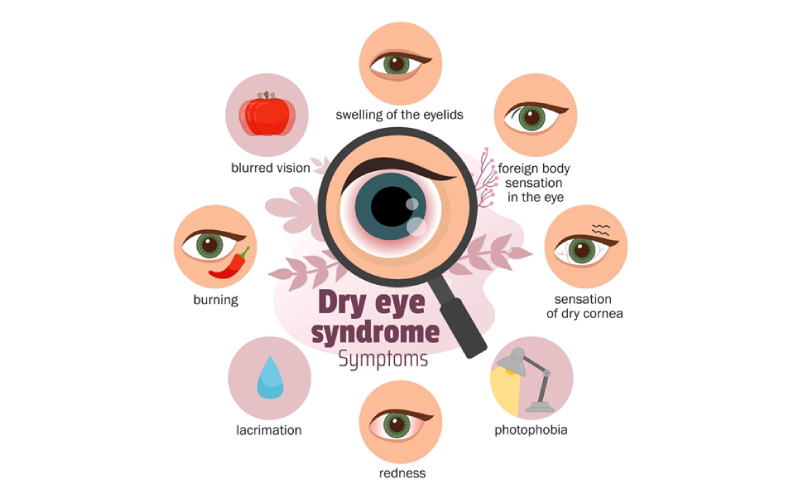
Dry Eye Syndrome
Dry eye syndrome occurs when there is insufficient tear production or when tears evaporate too quickly, leading to dryness and discomfort in the eyes.
- Symptoms: Dryness, watering eyes, foreign body sensation, burning, stinging, frequent blinking, photophobia (sensitivity to light), blurred vision, inability to sustain long periods of looking at things, and easily fatigued eyes.
- Prevention: Reduce prolonged screen time, maintain indoor humidity, avoid eye strain, and ensure adequate hydration.
How TCM Understands the Causes of Dry Eye
In Traditional Chinese Medicine (TCM), dry eye falls under the categories of 白涩症 or 神水将枯. Its core pathogenesis is tightly linked to the imbalances of specific organ systems:
- Liver and Kidney Yin Deficiency: The Liver opens into the eyes. A shortage of Liver blood or a depletion of Liver and Kidney Yin fluids deprives the eyes of essential nourishment, resulting in dry eyes, blurred vision, and an inability to look at objects for long periods. This is often accompanied by full-body symptoms like soreness and weakness in the lower back and knees, dizziness, tinnitus, insomnia, and vivid dreaming.
- Lung Yin Deficiency: The Lung governs dispersion and descending functions, responsible for distributing fluids throughout the entire body. Prolonged exposure to wind, sand, and dust, or spending long hours in extremely dry environments, consumes Lung moisture. This leads to insufficient Lung Yin, leaving the eyes unlubricated. Patients experience dryness, a foreign body sensation, a few red thread-like vessels on the whites of the eyes, often paired with a dry throat, dry mouth, dry cough, and constipation.
- Spleen and Stomach Damp-Heat: Disruption in the Spleen and Stomach’s transportation and transformation functions generates damp-heat. Alternatively, residual heat from an incomplete recovery of another illness can steam upward to the eyes. This causes dry eyes and mild redness inside the eyelids, accompanied by sticky eye discharge and bad breath.
- Qi and Blood Deficiency: TCM holds that Blood nourishes the whole body, while Qi is the driving force that moves Blood. If chronic illness, aging, overexertion, or a weak Spleen and Stomach result in a deficit of Qi and Blood, the eyes lose their source of vitality. These patients present with dry eyes, frequent blinking, photophobia, eye fatigue, alongside systemic signs like a sallow complexion, general exhaustion, palpitations, insomnia, and dizziness.
- Liver Stagnation Transforming into Fire: High workplace stress and mental tension cause Liver Qi to stagnate. Over time, stagnant Qi transforms into fire. Because fire naturally flares upward, it disturbs the eyes. Beyond dry, burning, and stinging eyes, patients often experience irritability, a bitter taste in the mouth, headaches, insomnia, and distending pain along the flanks and ribs.
Common TCM Therapeutic Approaches
TCM prioritizes holistic care via syndrome differentiation and customised treatment, creating personalized protocols based on every individual’s unique constitution and symptom profile.
1. Oral Herbal Medicine
A practitioner will prescribe targeted herbal formulas based on your specific pattern:
- Nourishing Liver and Kidney: Formulas like Qiju Dihuang Pills (杞菊地黄丸) are used for the Liver-Kidney Yin deficiency type, using ingredients like goji berries and chrysanthemum to nourish the organs and brighten vision.
- Nourishing Yin and Moistening the Lung: Formulas like Shashen Maidong Decoction (沙参麦冬汤) target Lung Yin deficiency, utilizing Sha Shen (Glehnia Root) and Mai Dong (Ophiopogon Tuber) to moisten the lungs and relieve dryness.
- Clearing Heat and Draining Dampness: Formulas like Baohe Pills (保和丸) or Erchen Decoction (二陈汤) are chosen for Spleen-Stomach damp-heat to clear heat and dry dampness.
- Boosting Qi and Nourishing Blood: Formulas like Bazhen Decoction (八珍汤) or Guipei Pills (归脾汤) address Qi and Blood deficiencies, employing Dang Shen (Codonopsis Root), Huang Qi (Astragalus Root), Dang Gui (Angelica Root), and Shu Di Huang (Prepared Rehmannia Root) to optimize ocular nourishment.
- Smoothing the Liver and Purging Fire: Formulas like Danzhi Xiaoyao Powder (丹栀逍遥散) or Longdan Xiegan Decoction (龙胆泻肝汤) are deployed for Liver stagnation turning into fire, using herbs like Chai Hu (Bupleurum Root), Dang Gui, Bai Shao (White Peony Root), Zhi Zi (Gardenia Fruit), and Huang Qin (Baical Skullcap Root) to unblock Liver Qi and clear heat from its source.
2. Acupuncture
Acupuncture stimulates local eye points and full-body points — such as Jingming (BL1), Shangjingming, Zanzhu (BL2), Sibai (ST2), Chengqi (ST1), Taiyang (EX-HN5), Sizhukong (TE23), Yangbai (GB14), Hegu (LI4), Zusanli (ST36), Sanyinjiao (SP6), Taixi (KI3), and Taichong (LR3). This helps unblock meridians, regulate Qi and blood flow, stabilize the tear film, and promote natural tear secretion.
3. Herbal Eye Steaming
This traditional external therapy involves boiling clearing and vision-brightening herbs like chrysanthemum, mulberry leaves, and cassia seeds, and using the warm herbal steam to gently hydrate and soothe the eyes.
Daily Lifestyle Advice
Complementing professional therapies with mindful habits is essential for long-term recovery:
- Rest and Sleep: Avoid staying up late and ensure adequate sleep. TCM reminds us that “prolonged looking damages the blood”; overworking your eyes depletes Liver blood.
- Humidify Your Space: Avoid staying in air-conditioned, dusty, smoky, or overly dry environments for too long. Using a humidifier can help.
- Blink Frequently: Remember to blink regularly while looking at screens to stimulate tear production.
- Follow the 20-20-20 Rule: To avoid eye strain while using electronic devices, look at an object 20 feet (about 6 meters) away for 20 seconds every 20 minutes.
- Dietary Restrictions: Cut back on spicy, deep-fried, and barbecued foods, as they generate internal heat and consume the body’s precious Yin fluids.
Note: Any TCM herbal or acupuncture treatment should always be conducted under the guidance of a registered TCM practitioner.
Food Therapy for Dry Eye
Using food therapy to address dry eye is a highly effective, gentle strategy. Because TCM views the eyes as a reflection of Liver health, the core focus of food therapy lies in nourishing the Liver and Kidneys while enriching Qi and Blood.
Nutrient Guidance
- Incorporate Vitamin A: An essential nutrient for the formulation of tears and maintaining a healthy cornea.
- Boost Omega-3 Fatty Acids: Healthy fats found in certain foods reduce inflammation and improve tear film stability, providing deep relief from eye dryness.
- Prioritize Anthocyanins: These powerful antioxidants boost microcirculation in the retina, significantly reducing eye fatigue.
Top Foods for Eye Health
- Goji Berries (Gou Qi Zi): One of TCM’s premier vision-brightening foods. They nourish Liver and Kidney essence and can be chewed directly, steeped as tea, or added to porridges and soups.
- Chrysanthemum: Known for dispelling wind-heat and clearing the Liver, making it excellent for relieving eye dryness and strain.
- Carrots, Pumpkin, and Corn: Yellow and orange foods are rich in beta-carotene, which converts to Vitamin A in the body.
- Spinach, Broccoli, and Kale: Dark green leafy vegetables packed with lutein and zeaxanthin to protect against blue light damage.
- Blueberries, Blackberries, and Purple Cabbage: Rich in anthocyanins to optimize eye microcirculation.
- Salmon, Sardines, and Walnuts: Excellent sources of Omega-3 fatty acids to lower inflammation and enhance tear quality.
- Animal Liver (Pork or Chicken Liver): Exceptionally high in Vitamin A. Enjoy in moderation due to its high cholesterol content.
Recommended Dietary Recipes
- Goji Berry and Chrysanthemum Tea (枸杞菊花茶)
- Ingredients: Goji berries 6g, Chrysanthemum 6g.
- Preparation: Place both ingredients in a cup, pour in boiling water, cover, and let steep for 5–10 minutes. Can be refilled with hot water multiple times throughout the day.
- Benefits: Clears the Liver, brightens vision, nourishes Yin, and moistens dryness. This is the simplest daily tea for dry eye relief.
- Carrot and Goji Berry Porridge (胡萝卜枸杞粥)
- Ingredients: Rice 50g, half a carrot, Goji berries 9g.
- Preparation: Wash the rice and dice the carrot. Place them together in a pot to cook into porridge. Right before the porridge is fully cooked, stir in the goji berries and simmer until ready.
- Benefits: Benefits Qi, nourishes Blood, brightens vision, and moistens dryness.
- Lily Bulb and Lotus Seed Soup (百合莲子汤)
- Ingredients: Dried lily bulbs 20g, Lotus seeds 20g, rock sugar to taste.
- Preparation:
- Soak the dried lily bulbs and lotus seeds in warm water until plump. If the lotus seeds contain green cores, remove them to eliminate bitterness.
- Place the soaked lily bulbs and lotus seeds in a pot with water.
- Bring to a boil over high heat, then turn to low heat and simmer for 30–45 minutes until the lily bulbs are soft and the lotus seeds are tender and powdery.
- Add rock sugar to taste, stirring until fully dissolved.
- Benefits: Lily bulbs nourish Yin, moisten the Lungs, clear the Heart, and soothe the mind. Lotus seeds strengthen the Spleen, tonify the Kidneys, and calm the spirit. This soup beautifully moistens dryness and serves as a wonderful dietary support for dry eyes, irritability, and insomnia caused by Yin deficiency with hyperactive fire.
💡 Friendly Reminder: These dietary recipes are meant to serve as supportive care. For long-term results, consistency is key. However, if your dry eye symptoms are severe, please seek medical attention and couple these remedies with professional TCM care.
