
Glaucoma
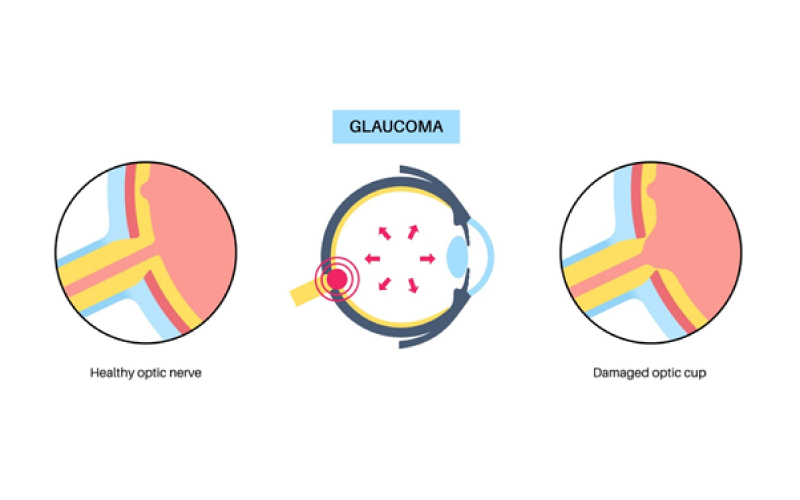
Glaucoma is a group of eye conditions characterized by progressive damage to the optic nerve and visual field defects, which is often associated with elevated intraocular pressure (IOP). In a healthy eye, aqueous humor is continuously produced and drained to maintain normal eye pressure. If the drainage system fails to function properly, intraocular pressure rises, which subsequently compresses and damages the optic nerve. The optic nerve is responsible for transmitting visual information from the eyes to the brain. Without timely and effective treatment, glaucoma can lead to permanent vision loss or even total blindness.
Causes of Glaucoma
Factors that can contribute to the development of glaucoma include:
- Genetics: Individuals with a family history of glaucoma face a significantly higher risk of developing the condition.
- Age: The risk increases with age, particularly after reaching 40.
- Severe Myopia or Hyperopia: Being highly nearsighted or farsighted increases susceptibility to the disease.
- Systemic Conditions: Chronic illnesses such as diabetes and hypertension are notable risk factors.
- Eye Injuries or Surgeries: Ocular trauma or surgical interventions can disrupt the normal drainage of aqueous humor.
Types of Glaucoma
The two most common types of glaucoma are:
- Open-Angle Glaucoma: This is the most prevalent form. It is frequently referred to as the “silent thief of sight” because it typically presents no early symptoms. Vision loss occurs slowly and painlessly over time, meaning patients often do not notice it until the disease has reached an advanced stage.
- Angle-Closure Glaucoma: This type often manifests as an “acute attack.” It is usually accompanied by severe eye pain, a hard or distended sensation in the eyeball, sharply elevated eye pressure, headaches, blurred vision, nausea, and vomiting. This is a medical emergency that requires immediate western medical attention, as it can cause profound, irreversible vision loss within a very short timeframe.
Symptoms of Glaucoma
- Open-Angle Glaucoma: Virtually asymptomatic in its early stages, with no noticeable decline in vision, making it extremely easy to overlook. In advanced stages, patients experience a constricted visual field, often described as tunnel vision (as if looking through a narrow tunnel).
- Angle-Closure Glaucoma: Symptoms are typically severe and sudden, including acute and intense eye pain, severe headaches, a sudden blurring of vision, seeing rainbow-colored halos around light sources, nausea, and vomiting.
Prevention and Care
If diagnosed and managed early, glaucoma can be effectively controlled to prevent further vision loss. Regular eye examinations are the single most critical tool for prevention and early detection. For individuals over 40, those with high myopia (greater than 600 degrees), or those with a family history, an annual comprehensive eye exam — including tonometry (eye pressure measurement) and an optic nerve assessment — is highly recommended. If any abnormality is detected, further targeted evaluations should be pursued promptly to confirm or rule out the condition.
Diagnosed glaucoma patients should regularly monitor and check their vision, intraocular pressure, fundus, and visual fields.
Lifestyle Guidelines for Patients:
- Avoid staying in dark environments for prolonged periods.
- Ensure adequate rest, prevent emotional agitation, and avoid staying up late.
- Keep bowel movements smooth to prevent straining.
- Avoid drinking large quantities of water all at once; it is best to limit intake to no more than 250ml at a time, waiting 30 minutes before drinking more.
- Adopt a light, easily digestible diet rich in vegetables and fruits. Strictly avoid spicy foods, tobacco, alcohol, strong tea, and coffee.
How Traditional Chinese Medicine (TCM) Views Glaucoma
In TCM, glaucoma is broadly classified under the category of “Wu Feng Nei Zhang” (Five Types of Wind-Induced Internal Cataract/Blindness). TCM holds that glaucoma does not arise from a single isolated cause, but is intimately linked to imbalances in internal organ functions, disrupted circulation of Qi and Blood, and pathologies within the Liver, Spleen, and Kidney meridians.
1. Angle-Closure Glaucoma
This corresponds to “Lv Feng Nei Zhang” (Green Wind Internal Blindness). It is primarily triggered by emotional depression, stagnation of Qi, and blazing fire in the Liver and Gallbladder, which leads to the stagnation and accumulation of Shen Shui (Divine Water / Aqueous Humor).
2. Open-Angle Glaucoma
This corresponds to “Qing Feng Nei Zhang” (Blue-Green Wind Internal Blindness). Its underlying patterns include:
- Liver Stagnation Transforming into Fire: The Liver governs emotional flow and dispersion. Prolonged emotional constraint, depression, or frustration causes Liver Qi to stagnate and transform into fire. This fire flares upward to disturb the eyes, resulting in elevated ocular pressure.
- Spleen Qi Deficiency: The Spleen governs transformation and transportation. When Spleen Qi is deficient, fluid metabolism fails, causing phlegm-dampness to stagnate and accumulate in the eyes, contributing to the development of glaucoma.
- Liver and Kidney Deficiency: With advancing age, systemic weakness, or in the late stages of chronic illness, Liver and Kidney essence and blood become depleted. The eyes lose their essential nourishment, leading to glaucoma. Furthermore, chronic Yin deficiency can damage Yang, leading to deficient Kidney Yang. Without sufficient Yang to warm and transport fluids, water stagnates and pools in the eyes, which can also trigger the condition.
Primary TCM Therapeutic Approaches
TCM focuses on holistic regulation. Through syndrome differentiation and targeted treatment, it aims to rebalance the constitution and promote the smooth circulation of Qi and blood in the eyes.
1. Oral Herbal Medicine
Based on a patient’s individual presentation, a practitioner will prescribe specific herbal formulas:
- Clearing Liver Fire: For patients presenting with rampant Liver fire, formulas like Longdan Xiegan Decoction (龙胆泻肝汤) are frequently utilized to clear the Liver and brighten the eyes.
- Smoothing Liver Qi: For those with Liver Qi stagnation, formulas like Xiaoyao Powder (逍遥散) are used to resolve constraint and harmonize emotion.
- Nourishing Yin and Subduing Fire: For Yin deficiency with hyperactive fire, formulas like Qiju Dihuang Pills (杞菊地黄丸) help nourish Liver and Kidney Yin while lowering deficient fire.
- Strengthening Spleen and Draining Water: For Spleen deficiency with dampness accumulation, formulas like Wuling Powder (五苓散) are selected to bolster the Spleen and eliminate fluid retention.
- Replenishing Essence for Sight: For severe depletion of Kidney essence, formulas such as Zuogui Pills (左归丸) are given to deeply nourish Kidney essence.
- Warming Yang and Transforming Fluids: For a decline in the Fire of the Gate of Life (Mingmen), formulas like Jinkui Shenqi Pills (金匮肾气丸) or Yougui Pills (右归丸) are deployed to warm and tonify Kidney Yang.
2. Acupuncture Therapy
Acupuncture is an integral component of TCM care for glaucoma. Stimulating specific points unblocks the meridians, harmonizes Qi and blood, enhances local circulation, and helps mitigate eye pressure.
- Periocular Acupoints (Around the Eyes): Points such as Jingming (BL1), Chengqi (ST1), Qiuhou (EX-HN7), Taiyang (EX-HN5), and Sibai (ST2) are used to directly optimize local blood flow.
- Systemic Acupoints (Body): Points like Fengchi (GB20), Hegu (LI4), Taixi (KI3), Taichong (LR3), Zusanli (ST36), and Sanyinjiao (SP6) are selected to regulate overall organ functions.
⚠️ Crucial TCM Reminder: While TCM prioritizes holistic constitutional balancing, intraocular pressure control via modern medicine is the baseline for managing glaucoma. During an acute attack of acute angle-closure glaucoma, you must seek emergency western medical intervention immediately to prevent irreversible blindness. For chronic glaucoma, an integrated approach combining Chinese and Western medicine can offer superior long-term management and vision protection.
Furthermore, because glaucoma is a chronic condition requiring long-term care, patients frequently experience anxiety and tension. TCM addresses this by managing emotional well-being. According to TCM’s Liver Stagnation theory, prolonged emotional distress compromises physical health. Traditional therapies like acupuncture and herbal medicine help smooth Liver Qi, calm the heart, and soothe the mind, enabling patients to maintain a positive mindset in managing their condition.
Diet and Food Therapy Principles
Dietary modification serves as a supportive tool to help stabilize intraocular pressure and improve overall vitality. However, food therapy cannot substitute for prescription medications or surgical interventions.
- Balanced, Nutrient-Dense Diet: Focus on whole foods rich in vitamins, minerals, and antioxidants, including fresh vegetables, fruits, whole grains, and lean proteins.
- Monitor Caffeine Consumption: Evidence indicates that excessive caffeine intake can cause temporary spikes in intraocular pressure. It is wise to limit coffee, strong tea, and colas.
- Small, Frequent Meals: Avoid eating large volumes of food in a single sitting — especially items high in sugar or salt — as this can trigger fluctuations in blood sugar and blood pressure, adversely affecting eye pressure.
- Incorporate B and C Vitamins: B vitamins are instrumental in supporting optic nerve health, while Vitamin C provides robust antioxidant protection beneficial to ocular tissues.
Recommended Dietary Recipes
These simple recipes can be incorporated into a glaucoma patient’s daily diet:
- Cassia Seed and Chrysanthemum Tea (决明子菊花茶)
- Ingredients: Cassia seed (Jue Ming Zi) 9g, Chrysanthemum 5g.
- Preparation: Place both ingredients in a cup, steep in boiling water for 10–15 minutes, and drink.
- Benefits: Both ingredients clear Liver heat and brighten the eyes, helping to alleviate ocular fatigue.
- Black Bean and Black Sesame Porridge (黑豆黑芝麻粥)
- Ingredients: Black beans 30g, Black sesame seeds 10g, Rice 50g.
- Preparation: Wash all ingredients, place them in a pot with an appropriate amount of water, and cook until a smooth porridge forms.
- Benefits: In TCM, “the Kidneys govern essence.” Black beans and black sesames enrich the Liver and Kidneys, offering excellent support for glaucoma rooted in Liver-Kidney deficiency.
- Stewed Pork Liver with Goji Berries (枸杞子炖猪肝)
- Ingredients: Fresh pork liver 100g, Goji berries (Gou Qi Zi) 20g.
- Preparation: Slice the pork liver. Place it into a stewing pot with the goji berries, add water, and double-boil (steam) until thoroughly cooked.
- Benefits: Pork liver is rich in Vitamin A, while goji berries nourish the Liver and Kidneys. This dish helps support visual acuity and is ideal for patients with Liver-Kidney Yin deficiency.
- Corn Silk and Plantain Herb Drink (玉米须车前草饮)
- Ingredients: Corn silk 30g, Plantain herb (Che Qian Cao) 15g.
- Preparation: Wash both ingredients well, decoct (boil) in water, strain out the herbs, and drink the remaining liquid.
- Benefits: Both corn silk and plantain herb promote urination and reduce swelling, assisting in reducing the accumulation of fluid within the eyes.
💡 Important Note: These food remedies are strictly complementary. They do not replace formal medical treatments. Please utilize them as part of your regular diet under the guidance of your physician and TCM practitioner. Continue to adhere strictly to your medical prescriptions and attend all scheduled follow-up eye examinations.
