
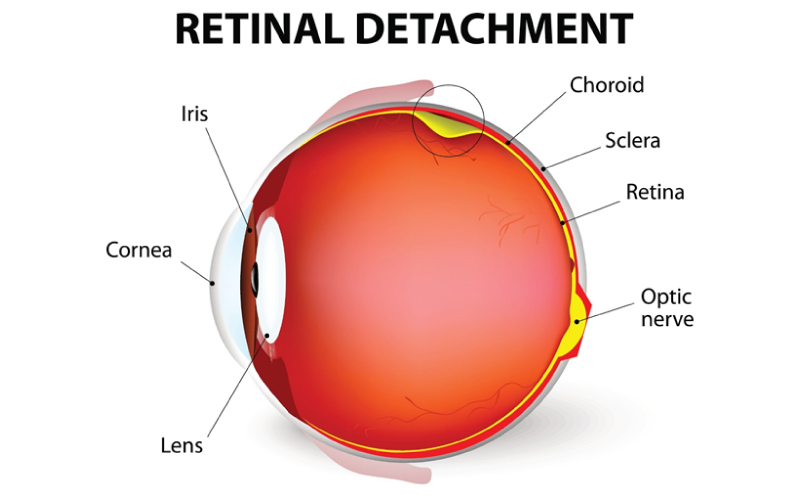
TCM Ophthalmic Insights on Syndrome Differentiation and Conditioning Strategies for Retinal Detachment
Retinal Detachment (RD) is one of the most severe, sight-threatening diseases in ophthalmology. Patients frequently present with symptoms such as flashes of light, a sudden increase in floaters, shadows blocking the visual field, or a sharp decline in vision. While modern medicine leans towards surgical repositioning as the definitive treatment, Traditional Chinese Medicine (TCM) ophthalmology focuses heavily on holistic conditioning and post-operative recovery. Through syndrome differentiation and management, TCM plays a supportive role in stabilizing the condition, accelerating recovery, and reducing the risk of recurrence. In TCM ophthalmology, this disease falls under the categories of Shi Yi Tuo Li (视衣脱离 – detachment of the visual coat), Shi Zhan Hun Miao (视瞻昏渺 – dimness of vision), and Bao Mang (暴盲 – sudden blindness).
Discussion of Pathogenesis in TCM Ophthalmology
TCM principles hold that “the Liver opens into the eyes” and “the Kidney governs the essence and generates marrow.” When Liver Blood is deficient and Kidney Essence is depleted, the fundus tissues are deprived of essential nourishment. This leaves the retina prone to thinning and degeneration, which can ultimately lead to detachment. Clinically, this is most commonly observed in high myopes, the elderly or infirm, and patients suffering from recurrent retinal detachment. This manifests as the root pathogenesis: “Liver and Kidney Deficiency as the Root.”
Furthermore, a sluggish circulation of Qi and Blood creates microcirculation barriers in the fundus. This leaves the retina poorly supplied with blood and impairs its innate capacity to self-repair. Patients often clinically present with distorted vision, visual field defects, and slow recovery. This represents the manifestation aspect: “Qi and Blood Stagnation as the Manifestation.”
Lastly, the Spleen governs transportation, transformation, and commands Blood. A weak Spleen causes internal fluid retention, which directly undermines the nutrient supply to ocular tissues, making the retina increasingly fragile. This serves as the foundational pathological mechanism: “Spleen’s Failure in Healthy Transportation as an Important Pathological Basis.”
Core Objectives of TCM Ophthalmic Conditioning
TCM conditioning is not intended to replace Western surgical intervention. Instead, it offers distinct advantages in the following areas:
- ✔ Stabilizing Retinal Status: Optimizes fundus circulation to reduce the risk of a secondary detachment.
- ✔ Accelerating Post-Operative Recovery: Helps clear subretinal fluid retention, assists in tissue repair, and speeds up the restoration of visual function.
- ✔ Enhancing Overall Constitution: Minimizes post-surgical complications and boosts long-term visual stability.
TCM Ophthalmic Conditioning Methods
1. Oral Herbal Medicine
TCM treatments are precisely tailored according to different syndrome types:
- Liver and Kidney Deficiency Type
- Principle: Nourish the Liver and tonify the Kidney, replenish Blood and brighten vision.
- Common Symptoms: Blurred vision, slow decline in visual acuity, stagnation of visual improvement post-surgery, dry and fatigued eyes, dizziness, tinnitus, insomnia, forgetfulness, and weakness or soreness in the lower back and knees.
- Qi and Blood Stagnation Type
- Principle: Invigorate Blood and unblock meridians, dissipate stasis and generate new tissue.
- Common Symptoms: Post-operative retinal edema or residual subretinal fluid, conjunctival congestion and swelling, a shadow blocking the visual field, distorted vision, slow recovery, and a distending headache or eye pain.
- Spleen Deficiency with Dampness Abundance Type
- Principle: Strengthen the Spleen and boost Qi, raise the clear Yang and drain water retention.
- Common Symptoms: Persistent subretinal fluid post-surgery, dim and hazy vision, generalized fatigue, a heavy and distending sensation in the eyes, poor appetite, and loose stools.
2. Acupuncture Conditioning
By stimulating specific acupuncture points around the eyes and along the body’s meridians to regulate Qi and Blood, acupuncture can achieve the following:
- Improve ocular microcirculation
- Dampen inflammatory responses
- Promote the functional recovery of optic nerves
This therapy is highly suitable for the post-operative rehabilitation stage.
Daily Lifestyle & Maintenance
TCM places a strong emphasis on “preventative care” (Zhi Wei Bing). Patients recovering from retinal detachment should carefully observe the following:
- ✔ Avoid Strenuous Exercise and Vibrations: Prevent any sudden impact or jerking motions that could pull on the retina.
- ✔ Manage Eye Strain: Reduce prolonged screen time on smartphones and laptops.
- ✔ Balanced Diet: Incorporate foods that nourish the Liver, Kidney, and Blood — such as black sesame seeds, goji berries, and dark-colored fruits and vegetables.
Clinical Significance of Integrating Chinese and Western Medicine
Modern research [1,2] demonstrates that Chinese medicine excels at improving the stability of retinal reattachment, promoting visual recovery, mitigating post-operative complications, and delaying or preventing re-detachment. Consequently, a structured approach is recommended for retinal detachment:
- Acute Phase:
Focus primarily on Western medical surgical intervention.
- Recovery Phase:
TCM conditioning offers pronounced advantages.
- Long-Term Care:
Effectively reduces the risk of recurrence.
The two systems work in tandem to maximize the preservation of visual function.
Conclusion
TCM categorizes retinal detachment as a condition of “Root Deficiency and Manifestation Excess” — a complex mix of deficiency and stagnation. By utilizing syndrome differentiation, holistic regulation, and a combined internal-external approach, TCM ophthalmology does not simply home in on local eye lesions. Rather, it focuses on the patient’s underlying constitution for long-term stability. It provides critical supportive value in post-operative rehabilitation, visual protection, and recurrence prevention, making it a pivotal complementary asset within the modern ophthalmology framework.
References
[1] Zhao L, Chen H, Xu Y. Adjunctive effects of Traditional Chinese Medicine on postoperative outcomes of retinal detachment: a clinical observation. Evidence-Based Complement Altern Med. 2020; 2020:1–8. [2] Li XX, Wang NL, Liu NP. Integrative Chinese and Western medicine in retinal disease rehabilitation. Chin J Integr Med. 2018;24(9):673–679.
