
Understanding Ptosis (Droopy Eyelids): Causes, Symptoms, and TCM Remedies
Have you ever noticed your upper eyelids looking unusually heavy, or perhaps one eye appears visibly smaller than the other? You might be experiencing a condition known medically as Ptosis — commonly referred to as drooping eyelids.
In Western medicine, it is called ptosis or blepharoptosis. In Traditional Chinese Medicine (TCM), we beautifully and descriptively refer to it as (上胞下垂), which translates to “the drooping of the upper ocular cell.”
Let’s dive deep into what causes this condition, how it manifests, and how TCM can offer holistic, natural support to lift your eyes — and your confidence — back up.
What Exactly is Blepharoptosis?
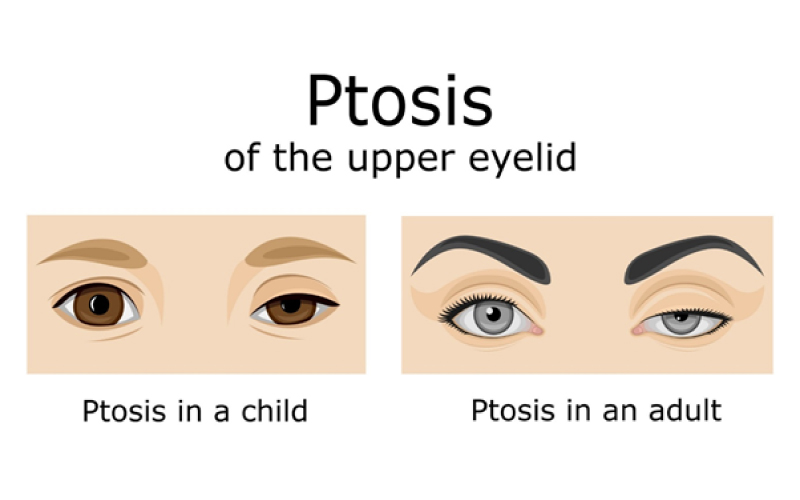
Blepharoptosis occurs when the upper eyelid lacks the strength to lift properly. This causes the eyelid margin to sag downward, narrowing the palpebral fissure (the opening between your eyelids) and partially or completely covering the pupil. It can affect just one eye (unilateral) or both eyes (bilateral), and it may be accompanied by abnormal eye movements or a decline in vision.
From a clinical diagnostic standpoint, a patient is diagnosed with ptosis when the upper eyelid covers more than 2mm of the upper border of the cornea (the black part of the eye), noticeably narrowing the eye opening.
What Causes Drooping Eyelids?
In modern medicine, ptosis is primarily caused by a malfunction or underdevelopment of the levator muscle (the muscle responsible for lifting the eyelid) or the oculomotor nerve (the 3rd cranial nerve) that controls it.
We categorize the causes into two types:
- Congenital Ptosis: Present right from birth due to improper development of the eyelid muscles.
- Acquired Ptosis: Developed later in life due to conditions such as Myasthenia Gravis, post-stroke sequelae, oculomotor nerve palsy, physical trauma (car accidents or impacts), viral infections following a cold or fever (due to compromised immunity), or external pathogenic factors (such as exposure to wind while sleeping under a fan or by the beach, which can trigger facial paralysis or a mini-stroke).
The TCM Perspective: The Spleen and the “Five Wheels”
In TCM, we believe that everything happening on the outside of our body reflects our internal balance. The classic TCM text “The Theory of Five Wheels” (五轮学说) states that the essence of all five organs flows upward to nourish the eyes, our windows to the soul. Each part of the eye corresponds to a specific organ system:
- The Upper and Lower Eyelids belong to the “Meat Wheel” (肉轮) and correspond to the Spleen. The Spleen governs the muscles and directly controls the lifting strength of the eyelids. Spleen deficiency and accumulated dampness often cause fluid retention, leading to under-eye bags or sagging eyelids.
- The Canthi (Corners of the Eye) belong to the “Blood Wheel” (血轮) and correspond to the Heart. The Heart governs blood vessels. Adequate Heart Qi and blood make the eyes sparkle (“Bright heart, clear eyes”). Anxiety or an unsettled mind can cause erratic eye movements.
- The Sclera (White of the Eye) belongs to the “Qi Wheel” (气轮) and corresponds to the Lung. This is connected to respiratory health. During a fever or cold, Lung heat causes the whites of the eyes to turn red, increase eye discharge, and make it difficult to open the eyes in the morning.
- The Cornea (Black of the Eye) belongs to the “Wind Wheel” (风轮) and corresponds to the Liver. The Liver opens into the eyes, and its meridian directly enters the eye system. A harmonized Liver allows us to distinguish colors and see clearly. It also governs tears; emotional stress can disrupt Liver Qi, causing tears to flow.
- The Pupil belongs to the “Water Wheel” (水轮) and corresponds to the Kidney. The Kidney stores vital essence. Children, possessing pure Yang energy and abundant Kidney essence, naturally have bright, luminous pupils.
Therefore, TCM attributes acquired drooping eyelids to Spleen and Stomach deficiency, insufficient middle Qi (Zhong Qi), and the failure of clear Yang energy to ascend, leaving the eyelids without the strength to lift. Alternatively, a weak Spleen can generate internal phlegm-dampness; when external Wind combines with this phlegm, it attacks the eyelids, damaging the meridians and causing them to droop.
Ultimately, ptosis is deeply rooted in imbalances of the Spleen and Stomach, deficiencies in Qi and Blood, and blocked meridians.
Clinical Signs and Symptoms
The presentation of ptosis varies significantly between children and adults:
1. In Congenital Cases (Infants & Children)
Children with ptosis will often tilt their heads backward or excessively wrinkle their foreheads (deep brow lines) just to see under their drooping eyelids. Some may even need to physically lift their eyelids with their hands to look at things.
⚠️ Early Detection is Critical: If a drooping eyelid blocks the pupil, light cannot reach the macula of the retina. Over time, the brain’s visual processing area for that eye can lose its function due to disuse, leading to permanent structural changes like strabismus (crossed eyes), amblyopia (lazy eye), or severe visual decline. Think of it like someone who can walk but sits in a wheelchair for years; eventually, the muscles atrophy and lose the ability to stand. Use it or lose it!
2. In Acquired Cases (Adults)
This is usually a slow, progressive process. Mild cases might only slightly cover the eyeball and affect appearance. Severe cases cover more than half of the eye. A signature symptom is “mild in the morning, severe in the evening” (晨轻暮重) — the eyes open relatively well upon waking but grow noticeably heavier and droopier by the afternoon and night as fatigue sets in, improving only after rest. If caused by a stroke or neurological issues, it may also cause double vision (diplopia).
3. In Older Adults
This is incredibly common. As we age, Liver and Kidney essence naturally decline. Since the Liver governs the tendons and muscles, depletion causes the eyelid tissues to lose elasticity and sag. Furthermore, in TCM, “excessive worry injures the Spleen.” Grandparents who constantly worry about their children and grandchildren weaken their Spleen and Stomach function, directly affecting the strength of their eyelid muscles.
Holistic TCM Management
The fundamental principles of TCM management for ptosis are to replenish Qi and nourish Blood, strengthen the Spleen and smooth the Liver, and dispel Wind to activate the collaterals. While this natural process requires time and patience, the results are highly rewarding.
Paediatric Tui Na for Children
For congenital cases in children, we combine specific oral Chinese herbs (focusing on warming the Kidneys and strengthening the Spleen) with Paediatric Tui Na (therapeutic massage). Historically referred to as the art of replacing acupuncture needles or medications with hands, modern Tui Na serves as a non-invasive alternative to surgery for young children. We recommend trying this approach consistently for about six months; if progress is insufficient, surgical intervention can then be considered.
Acupuncture & Herbs for Adults
For adults, a combination of customized herbal decoctions and targeted acupuncture yields the best results.
- Custom Herbal Formulations: Based on your specific pattern, formulas like Longdan Xiegan Decoction (龙胆泻肝汤) are used to clear Liver fire, while Xiaoyao Powder (逍遥散) smooths stagnant Liver Qi. If there is a Yin deficiency, Qiju Dihuang Pills (杞菊地黄丸) help lower deficient fire. For Spleen deficiency with dampness, Wuling Powder (五苓散) is selected, whereas Zuogui Pills (左归丸) replenish Kidney essence. For declining vital fire, Jinkui Shenqi Pills (金匮肾气丸) or Yougui Pills (右归丸) are deployed to warm Kidney Yang.
- Ocular Acupuncture (Highly Recommended!): Acupuncture is incredibly powerful for ptosis. By stimulating local points around the eyes — such as Jingming (BL1), Chengqi (ST1), Qiuhou (EX-HN7), Taiyang (EX-HN5), and Sibai (ST2) — we can optimize blood circulation, enhance muscle contraction, and stimulate the nerves to regain elasticity. To target the oculomotor nerve (the 3rd cranial nerve controlling the lifting muscle), points like Yangbai (GB14) are precisely stimulated. It is safe, tailored to your condition, and has minimal side effects.
Daily Lifestyle & Care Guidelines to Lift Your Eyes
To ensure long-lasting results and prevent recurrence, adjusting your daily habits is absolutely essential.
1. Give Your Eyes True “Rest”
Many of us finish a long day of answering emails, reading documents, and creating presentations only to unwind during “Me Time” by binge-watching television dramas or scrolling through social media on our phones in a pitch-black room before sleep. While your mind might feel entertained, your eyes have had zero rest. Over time, the overstrained eye muscles simply give up, leading to droopiness or involuntary eyelid twitching.
Think of it like hiking up Bukit Timah Hill, immediately spending hours walking around Orchard Road, and then pacing around a park before going home — your calf muscles are bound to cramp up from sheer exhaustion!
2. Focus on Spleen-Nourishing Nutrition
Incorporate homemade herbal soups into your weekly meals using ingredients that strengthen the Spleen and moisten the Lungs, such as Codonopsis Root (党参), Poria (茯苓), Coix Seed/Barley (薏苡仁), Chinese Yam (山药), Lily Bulbs (百合), Lotus Seeds (莲子), and Astragalus Root (黄芪). Ensure your three daily meals are consumed at regular times and in balanced quantities.
3. A Warning on Temporary Fixes vs. Root Causes
Sleeping late accelerates aging and causes premature graying of hair. Some patients opt for cosmetic surgery to physically lift the eyelid, but because they fail to change their exhausting lifestyle habits, the ptosis returns. I have known patients who underwent surgery multiple times! Surgery can also carry side effects, such as the inability to close the eyelids completely during sleep, leading to severe dry eye syndrome.
Similarly, cosmetic injections can sometimes leave synthetic materials trapped locally, congesting Qi and blood flow and causing facial stiffness. True, natural beauty comes from within — when you regulate your internal Qi and blood and strengthen your Spleen, your eyelids will naturally lift.
4. Simple Daily Self-Care Routines
- DIY Eye Massage: Use your fingertips to gently massage the points around your brow bone and eyes — Zanzhu (BL2), Yangbai (GB14), Jingming (BL1), and Yuyao (EX-HN4) — in gentle, smooth circular motions to relieve tension.
- Pat the Baihui Point for Cold Hands & Feet: If you suffer from a weak Spleen and constantly cold extremities, step out into the morning sun between 8:00 AM and 9:00 AM and gently pat the top of your head — the Baihui (GV20) point, where all the body’s Yang energy converges. This helps elevate your body’s clear Yang energy.
- Massage Your Earlobes: In reflexology, the earlobes directly correspond to the eyes. Before going to sleep, gently pinch and rub your earlobes until they feel comfortably warm to promote ocular circulation.
Summary
Drooping eyelids are a clear signal from your body that your internal organs, particularly your Spleen and Liver, are exhausted. By pairing professional TCM management like acupuncture with mindful lifestyle changes, you can restore strength to your eyes naturally.
If you or your child are experiencing persistent eyelid heaviness, consider scheduling a consultation with a registered TCM practitioner to catch it early and create a personalized plan.
