
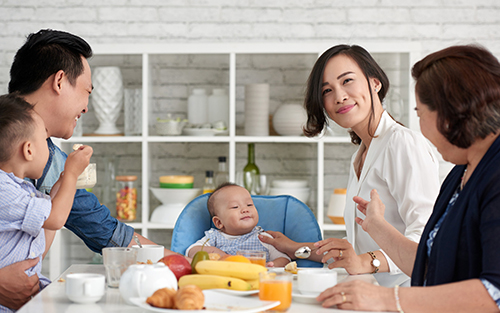
EXPERT TIPS TO GET STARTED WITH BABY-LED WEANING
1. From a TCM’s point of view, when is the right time to introduce solid foods to babies?
TCM advocates the feeding of breastmilk from birth and believes it is the best food for babies, but it may not be able to keep up with the increasing nutritional demands of the growing baby as he/she progresses towards six months old. From six months to one year old, babies’ sense of smell and taste is the most sensitive, thus this is the right time to start the introduction of solid foods with a wide variety of food types and tastes with well balanced nutrition to them. Through tasting more food variety, the baby will further develop their sense of taste and smell, and grow up to be more receptive to all kinds of food and tastes, thereby reducing the chances of becoming picky or selective eaters.
Other consideration factors also include the baby’s weight, i.e. when the baby has grown to twice his/her birth weight, or at least six kilograms; or when the baby has achieved considerable milestones such as having more neck control, being able to sit up, turn necks and heads to stimuli; or the baby is showing signs that his/her usual feeds are unable to satisfy their hunger; or when the baby starts showing interest in food when adults are dining, or able to demonstrate biting actions etc, it may be an appropriate time to start including solid foods in their daily diet.
2. What are the do’s and don’ts of feeding solid foods to babies?
From six months old, it is suggested to first introduce grains such as rice, millet or oats to babies. It is essential to ensure that the baby is fully receptive to these grains, before adding on new food types such as vegetables and fruits blends, small and mashed fish meat etc. Take note to only introduce one new food type at a time, and from small to larger quantity, from smoother to harder texture. Stay with the food type for three to five days before introducing the next food type. Egg white and honey should not be given to babies below one year old. For babies with food allergies family history, it is suggested to start weaning one to two months later from the six month old mark, and should they avoid potential allergens such as shellfish, peanuts and egg whites till the child reaches three years old.
Introduction of food types can be done with creativity made to colours and shapes combination for a more pleasant eating experience. Babies who enjoy eating will be more receptive to weaning and grow up to be healthier. Food given to babies should be fresh and handled with care. When they fall sick or experience tummy pains after eating a particular type of food, they risk becoming adverse to eating, and this hinders the progress of weaning. Dining environment should be comfortable, without the use of television or digital devices to distract the baby so he/she can focus on eating and completing his/her meal.
Babies’ tummy capacity and digestive system is also not yet mature, hence overeating per meal should be avoided. Breakfast is the most important meal, and should always be given to replenish the body’s nutritional needs for the day after a long night of sleep. Babies who skip breakfast would exhibit legathy, inability to focus and learn, and are slower to respond to stimuli. Overtime, it will cause harm to their growing brains. Their three meals a day should also be given at regular timings to develop good eating habits. Dinner should be taken two hours before bedtime to avoid indigestion and sleep disturbance.
Remember to check the temperature of the soups and foods before serving to babies to avoid scalding. Do not chew the foods before feeding babies as some bacteria from the adults’ mouths can be passed to the babies through such feeding methods. Moreover allowing the babies to chew their food strengthen their teeth, and also aid in the secretion of saliva and digestive enzymes.
3. What is the TCM food guide for babies and children?
TCM believes 脾为中土, meaning our digestive system is the one which helps to provide essence to make Qi and Blood for our body, thus places a strong emphasis on the well functioning of our Spleen, and the need to start babies well on their food journey.
According to The Five Elements, the different colours of food types enter into different organs, for instance, the colour white enters the Lungs meridian, hence food types which nourishes the Lungs are mostly whitish in colour. White foods are generally mild in nature and are able to replenish Yin in our body, thus is suitable for most body constitutions. White foods recommended for babies and children are lotus roots, winter melons, rice grains, pears, and lily bulbs.
Five Elements also consist of Five Flavours which categories foods into five medicinal tastes – pungent, sweet, sour, bitter and salty. Each of these five flavours has different therapeutic effects, of which foods with the taste of sugar has the abilities of tonifying and replenishing, harmonizing the middle energizer, adjusting medical properties, releasing spasms and relieving pain. They are food types which enter the Spleen meridias. From grains, foods which are suitable for the building of Spleen and are of warm properties include rice grains, wheat grains, corn and beans. In fruits and vegetables, pumpkin, Chinese Yam, yam, apples and bananas are of this nature.
The overall principal of food introduction for baby led weaning should be progressive in terms of food volume, texture, taste and variety, starting with small amounts of soft, liquid and individual food types to give time for the Spleen to develop well as follows:
| 6 Months | Rice cereal, congee, egg yolk, mashed fish such as threadfin, cod, seabass, salmon etc, tofu, vegetables puree, fruits puree etc |
| 7 to 9 Months | Cut noodles, baby biscuits, shredded vegetables, fish and poultry etc |
| 10 to 12 Months | Porridge, soupy rice, buns, breads, pastas etc |
It is important to provide babies with a well balanced menu, ensuring they intake all rounded nutrition from more food types. Build in poultry, fish and eggs gradually into their diet. Poultry provides protein which gives the energy for their brains development. Amino acids from fish is most suitable for use and most easily absorbed by babies, thus an important source of DHA for them. Lecithin from eggs helps develop their memory. Fruits and vegetables are essential too, especially carrots and apples, as carrots contain carotene that speeds up brain metabolism while apple enzymes aid build memory capacity. Good choices of grains are rice, oats, millet and soybeans.
Foods high in protein and recommended for babies are dairy products, poultry products, eggs, fish, shellfish, tofu, sesame, grains, walnuts, almonds etc. Other critical nutrition includes sugar, coming mainly from grains, and fruits and vegetables that naturally contain sugars appropriate for babies, to cope with their high growing needs; quality fats such as avocado, olive oil, beans for their proper growth and development; vitamins C, B, A and E from baby spinach, citrus fruits, barley, bananas, oats, carrots, cheese, salmon etc, for overall immunity boosting; and calcium from dairy products and iron from poultry products.
Babies are at a development stage and their digestive system and gut are not yet fully mature, hence it is important to do proper selection of methods of cooking baby’s food. Avoid making the food overly oily, hard, strong in tastes, too deep fried or too salty. It is recommended for babies to intake less than 4g of salt daily to avoid adding burden to their kidneys. Research has also shown that babies below one year old who over takes monosodium glutamate (MSG) risk damage to their brain cells resulting in slower reaction time and poorer memory.
Soups made with poultry meat, or bones, or vegetables are most suitable for babies. Be reminded to remove excess oil from the soups from serving to babies to reduce burden on their gut. Water is always the best, ensure babies and children take in sufficient water at regular intervals.
Combining modern science research and ancient TCM teachings, it is recommended for babies and children to “take good breakfast, full lunch and little dinner”. According to the Chinese Medicine Body Clock basing on a 24-hour time period, each period of 2 hours involves the changes in human body’s physiological function, pathological changes, and also their relationship with each of the Five Organs. Thus it is preferred that breakfast is fed between 7am to 9am, involving light foods which are easily digested; lunch is fed before 1pm, consisting of protein-rich ingredients; dinner is fed between 5pm to 7pm with light and nutritional foods.
In the morning when babies and children get up at 7am, start them off with a cup of warm water to replenish the dry tummy and intestines. Avoid taking naps straight after lunch to allow proper digestion and absorption. Giving some simple snacks at 4pm is nourishing to the gastric. Avoid lying down straight after meals, and try to stand for 30mins without vigorous exercises inatead. Avoid suppers right before bedtime.
4. Can TCM help increase the appetite of picky babies?
Yes, TCM can assist to increase babies’ appetite by strengthening their gut and digestive system through the use of delicate treatment strategies such as internal methods like herbal prescription and/or external methods like paediatric tuina, acupuncture, cupping, moxibusion, herbal inhalation etc. Special attention will also be given to the choice of herbs, dosage and administration of herbal prescription etc.
Due to the child’s tender age, it is recommended to select herbs with properties which are not too extreme, and able to assist to boost their appetite and helps with their digestion and nutrition absorption. Herbs which aids digestion of food, reducing the burden of our gut, and at the same time boosts the function of our Stomach and Spleen and improves the absorption and distribution of nutrients in our body are beneficial for picky babies. Some of these herbs include 山楂,神曲,麦芽,谷芽,鸡内金.
Other herbs aid in the removal of excess dampness in our Spleen and promote a healthy bowel movement by working on the intestinal mucosa such as 黄芪,党参,山药,白术,苍术,茯苓,大枣,瓜蒌,火麻仁,麦冬,蜂蜜 etc. Research has also shown that 七味白术散 is helping in the growth of good gut bacteria. With a strong gut and digestive system, picky babies will be more receptive to new food types through their boosted appetites.
We also work together with parents who play a major role in the prevention of gut problems. Breastfeeding mothers should strive for a healthy and balanced diet to ensure the newborn babies get sufficient nutrients such as proteins, minerals (iron, zinc and calcium etc), and vitamins (Vit D, Vit E etc) which are essential for normal growth development. Avoid giving cold foods and drinks to babies which will harm the Yang of Spleen, giving rise to gut problems. Cultivate regular meal times and volumes, limiting on snacks and sweets. Practise good eating habits like hands washing before meals and no vigorous activities after meals. Make eating a happy process. Observe the pooing habits and stools of the child to pick up any irregularities early. Encourage intake of water and other healthy liquids.
It is also important to note that children should not have an excessive intake of tonics. With a healthy diet and lifestyle, a child will grow and develop well and naturally. With excessive intake of tonics unnecessarily, it may harm the normal functionality of their Spleen, thereby affecting digestion, absorption, and bring about a series of gut related disorders, or even early maturation for picky babies. Tonics should be taken moderately and appropriately only to replenish areas which the child is lacking in.
Other treatment methods include paediatric tuina, which is an effective external therapy in TCM, stimulating specific acupressure points or areas, unique to children, for the treatment and prevention of paediatric diseases brought about through picky eating habits. It also helps to stimulate growth and brain development in children. It combines massage, acupressure stimulation and other forms of body manipulation by applying pressure to acupoints, meridians and groups of muscles of nerves to remove blockages to promote the free flow and optimal circulation of qi and blood.
Its execution is convenient, painless, enjoyable, and non-invasive, and is performed according to the characteristics of children’s physiology and pathology. The effects of paediatric tuina for common paediatric diseases of the respiratory system (such as flu, fever, cough, asthma etc) and digestive system (such as stomach ache, diarrhea, constipation, vomiting, poor appetite etc) are pronounced. Paediatric tuina is also suitable for illnesses like frequent bedwetting, night crying, myopia etc, and is useful to improve their overall health by strengthening the child’s immune system.
If required, acupuncture, moxibusion and cupping are other treatment methods worth considering for children. The selection of acupoints is precise, acupuncture needles are usually shorter, and execution is brisk and gentle, with the assistance of heating lamp. Sometimes the needles are remove right away after stimulating the acupoints. Moxibusion is also done briefly due to their tender skin, hence timing of the treatment is well controlled till the skin shows mild redness and warmth. Cupping is executed for older children with medical grade silicon cups with appropriate cupping duration according to the child’s age and medical condition.
